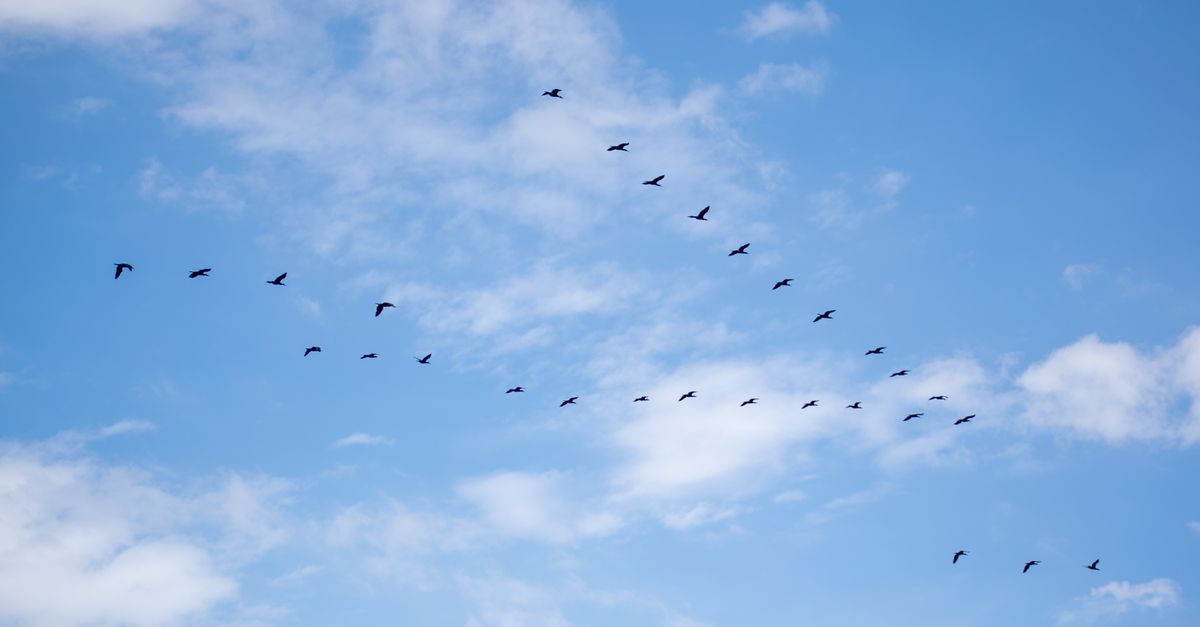
Each autumn, billions of birds migrate south, many at night. Some travel thousands of miles and return to the same breeding area the following spring. They do it without maps, using a toolkit of senses that scientists are still working to understand.
Key Takeaways
- Birds use several compasses: the sun, star patterns and Earth’s magnetic field.
- Young birds of many species inherit a direction and distance to travel.
- Landmarks, coastlines and possibly smells help with fine navigation.
- Light pollution can disorient night-migrating birds.
The sun compass
Birds can use the sun’s position to determine direction, adjusting for the time of day with their internal clocks. Experiments in the 1950s by Gustav Kramer showed caged starlings oriented according to the sun and that shifting their perceived sun position with mirrors changed their direction.
The star compass
Many songbirds migrate at night. In the 1960s Stephen Emlen tested indigo buntings in a planetarium and found they learned to orient using star patterns around the north celestial pole. Young birds learn which point in the night sky stays fixed.
The magnetic compass
Birds can sense Earth’s magnetic field. A leading hypothesis is that proteins called cryptochromes in birds’ eyes are involved, possibly allowing them to perceive magnetic fields visually through a quantum chemical process. Iron-containing structures have also been studied as possible magnetic sensors. Research continues.
Inherited directions
Experiments with blackcaps, a European warbler, showed that young birds raised without adults still oriented in the correct direction for their population. Cross-breeding birds from populations with different migration routes produced offspring with intermediate directions, evidence of a genetic component.
Maps and landmarks
Experienced birds can correct for displacement, suggesting a “map” sense. They also use coastlines, mountain ranges and rivers. Some seabirds may use smell to navigate over oceans.
Record-breakers
- Arctic terns fly between the Arctic and Antarctic, covering huge distances each year.
- Bar-tailed godwits have been tracked flying nonstop from Alaska to New Zealand, more than 11,000 kilometres.
- Ruby-throated hummingbirds cross the Gulf of Mexico.
Threats
Night-migrating birds can be disoriented by bright artificial lights, especially on cloudy nights, and collide with buildings. “Lights Out” programmes in many cities encourage turning off unnecessary lights during migration seasons.
How you can help
- Turn off unnecessary outdoor and indoor lights at night during migration.
- Use window treatments or markers to prevent collisions.
- Plant native plants that provide food.
- Report sightings to citizen science projects.
Frequently Asked Questions
Do birds sleep while migrating? Some species can take very short sleeps, and frigatebirds have been recorded sleeping with one brain hemisphere at a time while flying.
Why do birds migrate at night? Cooler air, calmer conditions and fewer predators are possible reasons, and it leaves daytime for feeding.
Do all birds migrate? No. Many species are resident year-round.
The bottom line
Migrating birds combine sun, stars, magnetism, inherited instincts and landmarks to find their way. Some of their senses still hold scientific mysteries.